

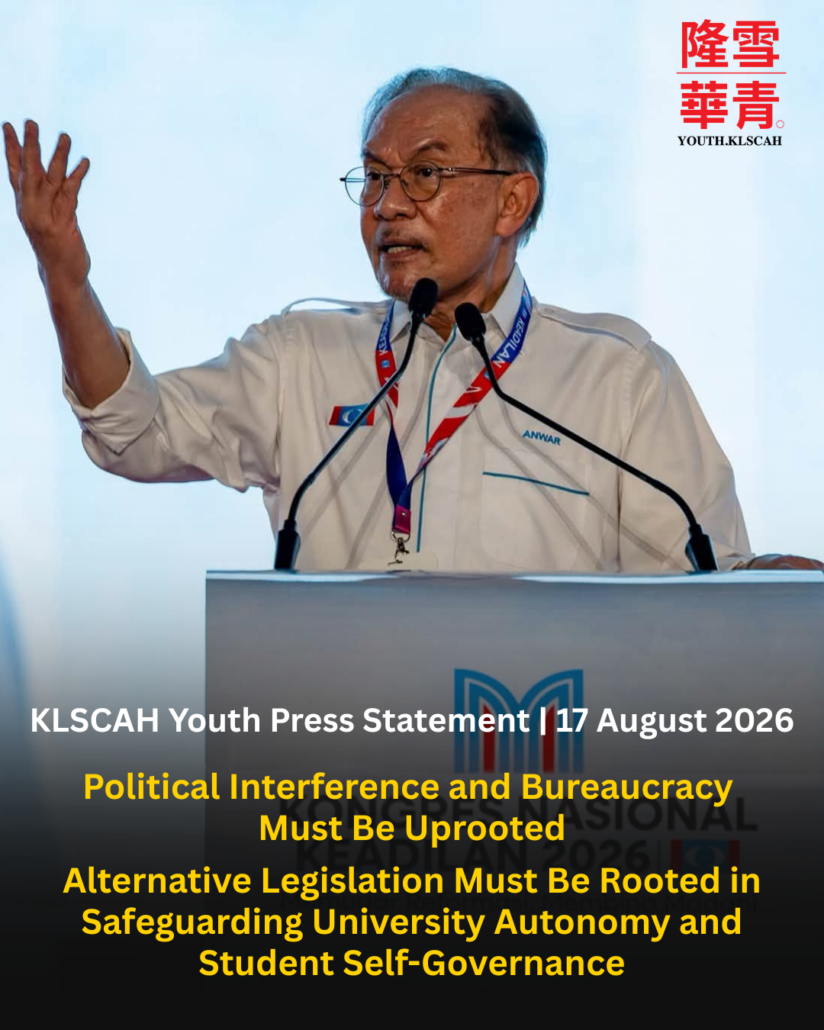
Political Interference and Bureaucracy Must Be Uprooted Alternative Legislation Must Be Rooted in Safeguarding University Autonomy and Student Self-Governance
In response to Prime Minister Anwar’s announcement regarding the abolishment of the Universities and University Colleges Act 1971 (UUCA), KLSCAH Youth Chief and MOE Committee Member for the Abolishment of the UUCA (2018–2020), Wong Yan Ke, urges the government to: immediately reinstate and empower the “Committee for the Abolishment of the UUCA”; publish a clear timeline; and initiate a stakeholder consultation mechanism.
He also calls upon student movement groups, academia, and civil society nationwide to remain perpetually vigilant, ensuring the government does not introduce draconian new laws that are merely “old wine in a new bottle” under the guise of reform.
“Years ago, the Najib administration, yielding to pressure, made false promises of reform by abolishing the Internal Security Act (ISA) and amending the Police Act; yet they subsequently and introduced the Security Offences (Special Measures) Act (SOSMA) and the Peaceful Assembly Act to continue policing the freedom of assembly and cracking down on civil society leaders, such as former Bersih Chairperson Maria Chin.”
Wong emphasises that Anwar’s verbal commitment is merely a starting point and by no means a victory for reform. The devil is always in the details; academics and students must supervise and participate in the drafting process of the abolishment or the new legislation to avoid repeating the mistakes of past administrations.
“During the tenure of the Madani government, the space for academic freedom, freedom of association, and student self-governance has not expanded; rather, it has contracted even further compared to the Pakatan Harapan 1.0 era. Various higher education institutions have revoked students’ autonomy to hold campus elections, University of Malaya auxiliary police brazenly obstructed an anti-corruption academic forum, and Universiti Malaysia Sabah initiated disciplinary action against protesting students. These oppressive actions make it seem as though we have regressed to the era when UMNO-BN ruled with an iron fist.”
Political Interference Must End
Looking back at Malaysia’s higher education history, during the golden era of the 1960s, the University of Malaya enjoyed a high degree of autonomy. However, the two amendments to the UUCA in 1971 and 1975 suffocated the very soul of the university. At the time, in order to suppress the student movement (such as the Tasek Utara and Baling farmers’ protests), Barisan Nasional forcibly passed draconian legislation. Not only did they treat academics and students as national threats, but they also directly consolidated the power to appoint the Vice Chancellor into the hands of the Minister.
“For half a century, this political interference has snowballed. Public universities have been reduced to political tools used to endorse the ruling party—from the 1MDB whitewashing convention to the “Malay Dignity Congress” co-organised by four public universities, campuses are rife with political calculations. The “corporatisation” reforms of the 1990s not only failed to deliver genuine autonomy but further diminished the voices of academics within the University Senate. Today’s universities are managed by bureaucrats and non-academics, blindly chasing international rankings and commercial interests, thoroughly deviating from the academic intent of seeking truth, fostering critical thinking, and serving society.”
Four Core Demands for Reform
Wong reiterates that the abolishment of the UUCA does not mean starting from scratch. The government must acknowledge the spirit of the 1969 Suffian Cabinet Committee Report (Suffian Report 1969) and the recommendations of the previous Committee for the Abolishment of the UUCA. The new legislation must be founded on “safeguarding rather than suppressing”, implementing the following four core reforms:
Firstly, Reject Political Interference. The Minister must surrender the direct power to appoint the Vice Chancellor and the Board of Directors, allowing university governance to become genuinely democratised.
Secondly, Defend Academic Freedom. The existing system treats public university scholars as “civil servants”, forcibly applying the Statutory Bodies (Discipline and Surcharge) Act 2000 (Act 605), which strictly prohibits scholars from publicly criticising government policies. The new legislation must explicitly stipulate the exemption of academic staff from Act 605. Academic freedom is not just the freedom to teach within a classroom; it crucially includes the freedom for public intellectuals to critique those in power and put forward discourses that drive societal progress, free from disciplinary action.
Thirdly, Discard Political Handouts and Implement “Formula-based Funding”. Government funding is absolutely not a political favour from the ruling party, but the hard-earned money of taxpayers. The new legislation must completely overhaul the current budget negotiation model of “block grants”. The government should implement a three-year cycle of “per-student funding”. Only by severing the government’s ability to use funding as a leash to demand obedience can universities attain true financial independence and institutional autonomy.
Fourthly, Uproot Bureaucracy Completely and Realise “Student Autonomy”. If Anwar is sincere about reform, he must immediately dismantle the paternalistic bureaucracy within universities. Student affairs and financial management must be entirely liberated from the hands of the “Student Affairs Division” (HEP) and handed over exclusively to the independent management of a democratically elected Student Union.
“University governance must be returned to the campus, back into the hands of academics and students. Any alternative legislation that violates the four core principles outlined above is merely a public relations stunt to fool the people and salvage the regime.”

